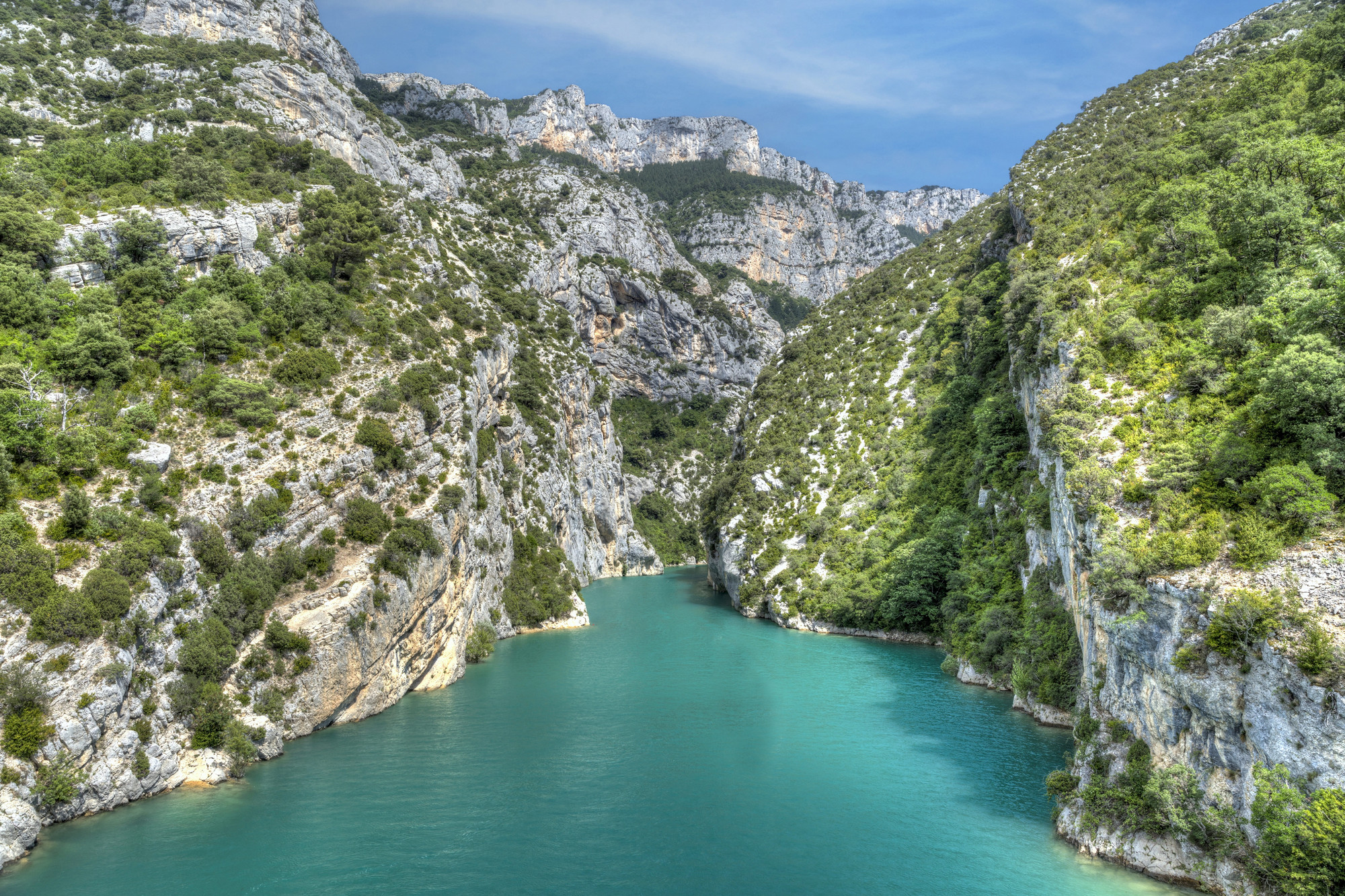
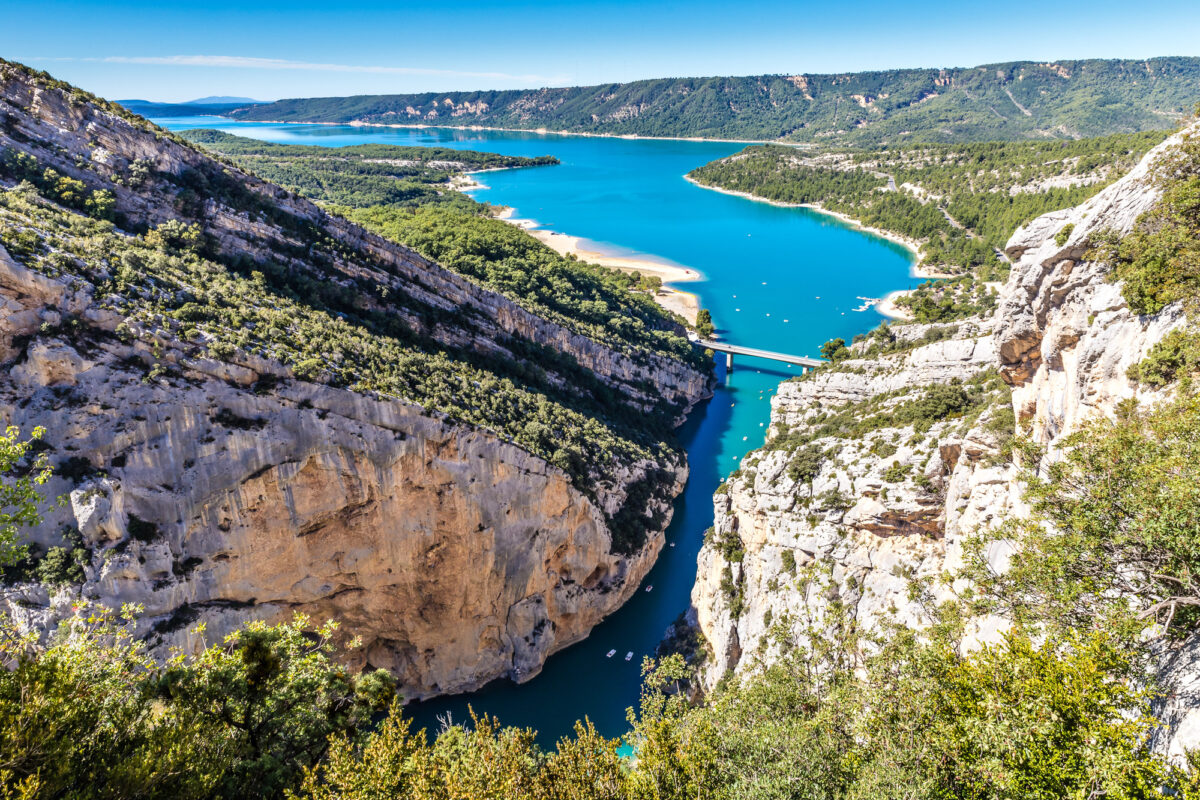
Provence tends to arrive in the imagination as lavender rows, stone villages and long lunches, so the first sight of the Verdon canyon comes as a genuine shock. Visiting the Gorges du Verdon means standing on a limestone rim with several hundred metres of air beneath you and a river the colour of bottled turquoise sliding along the floor of it. This is the wild, vertical side of southern France, and it sits within easy reach of the vineyards and markets most travellers come for.
The Verdon river has spent a very long time cutting through soft limestone, and the mineral content is what gives the water its improbable green-blue. At the western end the gorge opens out and empties into Lac de Sainte-Croix, a broad lake ringed by low hills, where the canyon walls narrow again as you head upstream. Sam Newman filmed part of his European trip here, on the rim and then on the water.
What visiting the Gorges du Verdon actually feels like
It feels big. Bigger than the photographs suggest and considerably steeper. Viewing platforms are cut into the cliff edge at intervals along the rim roads, and from most of them you can see the river as a thin ribbon a very long way down. Trails drop from the rim to the water, and while they are marked, the marking is not always generous. Sam and his travelling companions took a wrong turn on the way down and spent forty minutes finding their way out of the forest, without mobile reception to fall back on.
That is worth knowing rather than worth worrying about. Wear proper shoes rather than sandals, carry more water than you think you need, take a photograph of the trail map at the trailhead while you still have signal, and treat the descent as the easy half of a walk that finishes uphill. Do that and the gorge rewards you generously.
On the water at Lac de Sainte-Croix
The most accessible way to get inside the canyon is from the lake. Boats are hired from the shore near the point where the river meets the water, and you can paddle or pedal upstream between the cliffs until the gorge narrows and the crowd of small craft thins out. Petrol engines are not permitted, which is why the whole place is so quiet, and why the loudest sound is usually water on rock.
A word to the wise from Sam’s day out: an e-ticket is not the same thing as an electric boat. The pedal boats are exactly what the name says. The upside is that you go slowly enough to look up properly, and the walls of the gorge deserve that. There are places where the rock has been scooped and polished into smooth convex shelves that would not look out of place in Western Australia. Sam compared one to Wave Rock, which is about right, on a smaller scale and with far better swimming underneath it.
Swimming
The lake is made for it. The water is cold, clear and startlingly coloured, and after a hot walk on the rim it is the whole point of the afternoon. Bring a towel in the car rather than assuming you will resist.
Driving the gorge
The roads that run along both rims are among the most spectacular in France and among the more demanding. They are narrow, they hug the edge, they are full of blind corners, and there is usually somebody behind you who drives them every week and would like to keep moving. Sam’s verdict on the drive was that it was nerve-wracking, and repeated it in case anyone missed it.
The answer is not to avoid the drive but to allow far more time than the distance suggests, to pull into the marked stopping points rather than braking for a view, and to let faster locals past whenever there is room. Split the driving between the two rims across two days if you can, so nobody spends the whole trip with their hands locked on the wheel.
Where to base yourself
The villages around the lake and above the canyon are small, stone-built and pleasant, and staying in one of them turns the gorge from a day trip into something more relaxed. Mornings are the best time on the rim, when the light falls into the canyon and the roads are quieter. Afternoons belong to the lake. Aix-en-Provence and the wider Provencal countryside are within comfortable driving distance, which is why the Verdon slots so neatly into a broader southern France itinerary.
When to go, and how it fits a wider trip
Late spring and early autumn are the sweet spot. The water is swimmable, the walking is not punishing, the roads are calmer and the light is at its best. High summer brings heat, traffic on the rim roads and busy boat hire, though it is also when the lavender country to the north-west is at its most photogenic, so there is a genuine trade-off to weigh up. Winter is beautiful and stark, but some of the rim roads and services close down.
For Australians putting together a few weeks in Europe, the Verdon works best as a two or three night pause between the coast and the hill country, with a hire car and no fixed schedule. It pairs naturally with the perched villages of the Luberon, the markets of Provence and a run down to the Mediterranean afterwards. Build in a spare afternoon. Between the walking, the driving and the swimming, this is not a place to be visited to a timetable, and the trips that work best here are the ones planned with room to move.