
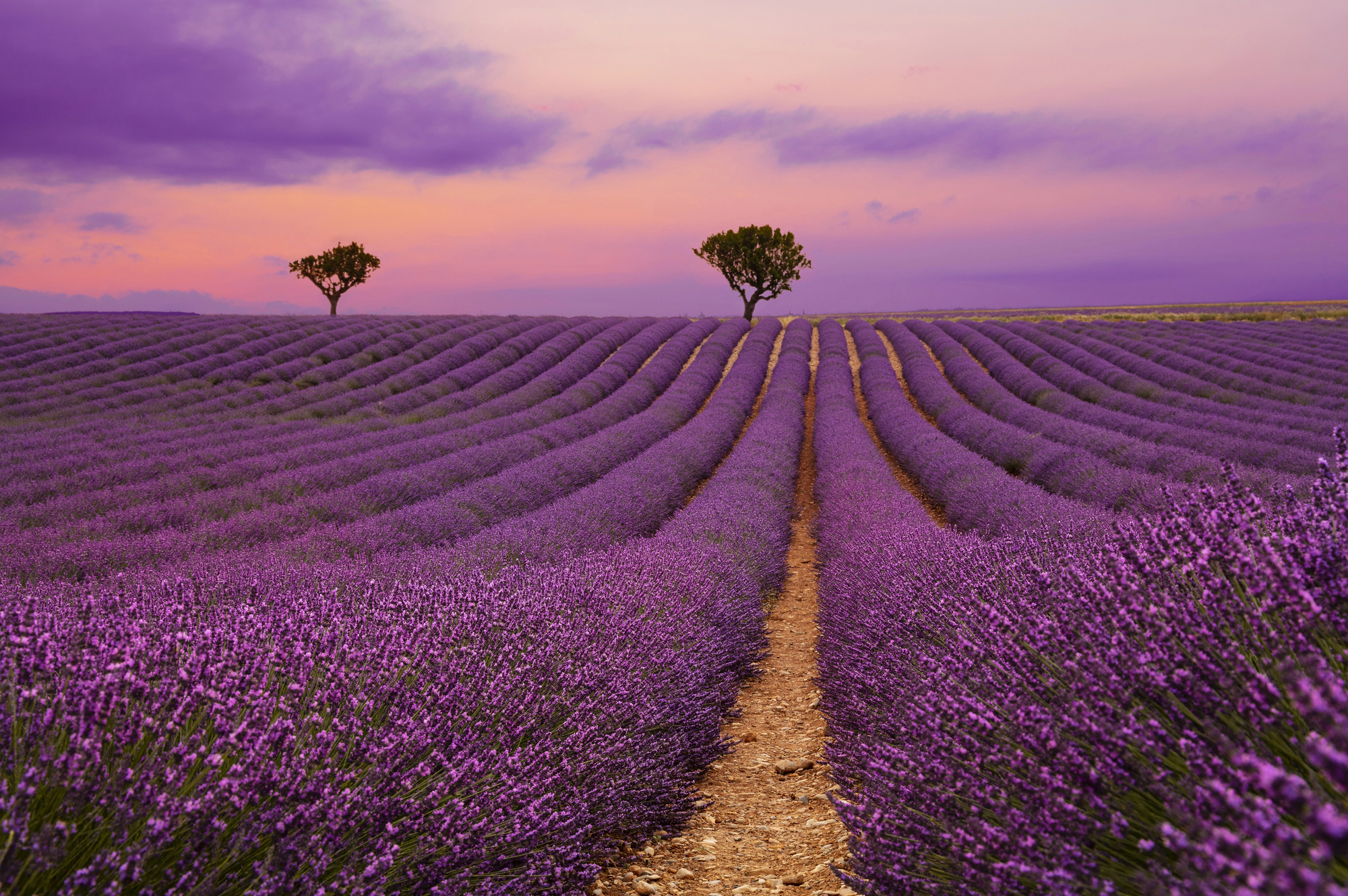
An hour and a half of driving to look at a crop growing in a paddock sounds like a hard sell from Melbourne. The Provence lavender fields are the exception. On the Valensole plateau in Alpes-de-Haute-Provence, the rows run to the horizon in ridges of violet and grey-blue, the light is enormous, and the scent reaches you well before the first field does. Sam Newman put it plainly while standing in the middle of one: you can smell it from kilometres away.
This is not a garden or an attraction. It is farmland, worked by people who make their living from oil, honey and dried flower, and that is exactly what makes it worth the flight. You are driving through a working landscape at the one moment in the year when it turns a colour nothing else in Europe quite matches.
Where the Provence lavender fields are at their best
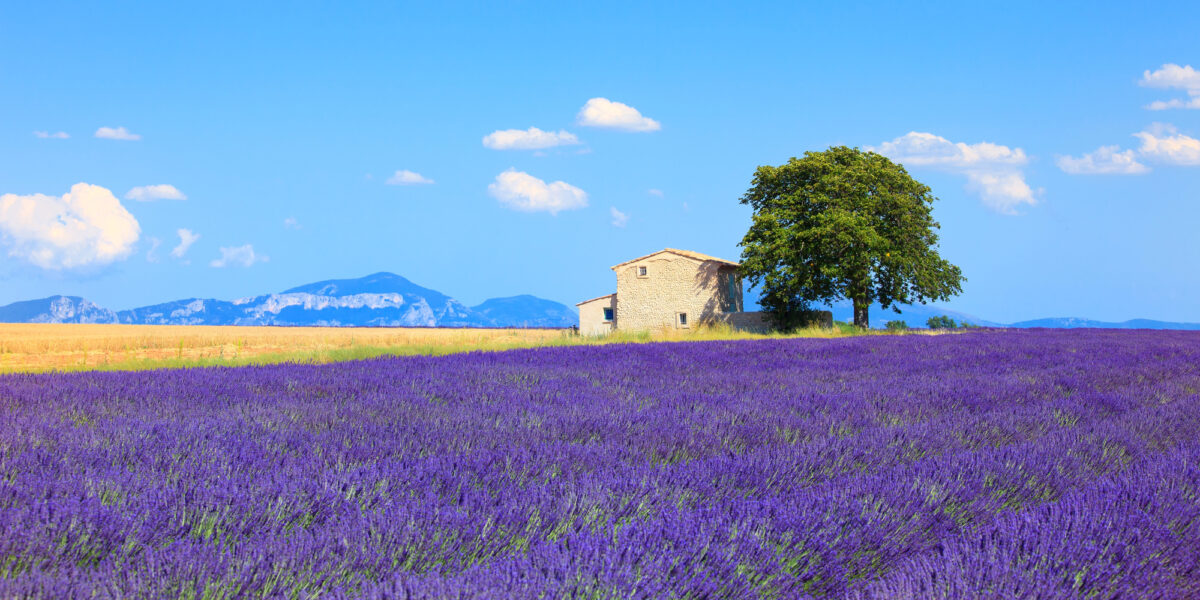
Provence grows lavender in several districts, but the plateau around Valensole is the one people picture. It sits high and open above the Durance valley, reached by climbing up from the direction of Manosque, and the terrain does the work: long, gentle sweeps of ground with very little in the way to interrupt a view. Sam was told, and repeated with some scepticism, that it is the most photographed of the lavender country. Standing there, the claim is easy to understand.
The fields are planted in the tight parallel lines that photograph so well, often with a stone farmhouse or a row of oaks set at the end of them. Elsewhere on the plateau the lavender shares the ground with sunflowers, which come on at much the same time and give you two impossible colours in one frame.
The village of Valensole itself
It would be a mistake to treat the plateau as a drive-through. Valensole village is old, compact and lived in, with narrow lanes climbing to a square that stays busy through the warm months. There are shopfronts selling the local product in every form, cafes with tables out, and the ordinary business of a Provencal town going on around the visitors. Sam described the walk from the quiet lanes into the bustling square, past shops where everyone just eats and drinks, and that is a fair summary of the rhythm here.
From the top of the village you get the wider picture: terrace after terrace of lavender falling away, kilometre after kilometre of it, which is the view that makes sense of the whole journey.
Leave the main road
The best of the plateau is not on the tourist route. Sam’s advice, delivered from a dirt track off the road into Valensole, was to skip the Eiffel Tower and the Champs-Elysees and come and see the lavender country off the beaten track instead. It is worth taking seriously. Turning onto a farm lane costs you nothing and puts you among the rows rather than beside them.
The small growers
Those back roads are where you find the family operations: a half-barrel of water by the gate, a table of honey and dried bunches, someone who is genuinely pleased to see a car pull in. Sam and his travelling companion stopped at one such place, run by a woman who had married a Frenchman and set up a small business selling coffee and refreshments beside her house. They were welcomed, sat down with lavender cake and a coffee that he rated highly, and watched the harvest going on in front of them with the bees working the rows. That half hour is the part of the day you remember, and it only happens if you build slack into the drive.
Driving it
A car is essential. The plateau roads are quiet and straightforward, but the interesting turnings are unsignposted and satellite navigation is not always reliable once you leave the main routes. Allow far more time than the distances suggest, carry water, and accept that you will stop constantly. Stay out of the middle of a field. It is a crop, and the growers ask that people photograph from the edges.
When to go, and what to build around it
Lavender is a high summer event. The bloom generally comes through from late June and holds into July, with harvesting under way once the flower is at its strongest, so timing is the single most important decision in the trip. Go a fortnight early and you have green rows; go late and you have cut stubble. Mornings and the last hour of light are kindest for both the heat and the colour.
Valensole works beautifully as one leg of a wider southern French itinerary. The Verdon gorge country is close by, the Luberon villages sit to the west, and the coast and its museum towns are within comfortable reach for the days either side. The trick is to base yourself somewhere in the region rather than day-tripping from a city, so the plateau is a short drive rather than a mission.
That is the approach Cartier World Travel took for Sam’s time in France. He filmed the end of his lavender day from the terrace of the Provencal house we arranged for him, and the value of that kind of planning shows up precisely on days like this one, when there is no schedule to keep and you can afford to follow a dirt track to see where it goes. We build our French itineraries the same way for everyone: the right base, the right week for the bloom, and enough room in the day for the stop you did not plan.
What Sam said
On the plateau: "You're standing in a lavender field ... you can smell it from kilometres away." On Valensole: "This is the most photographed and tourist place of the lavender fields." On the back roads: "If you come to France, don't worry about going and seeing the Eiffel Tower or the Champs-Elysees, come and see the lavender fields off the beaten track." On the roadside stop: "She ran out and greeted us ... this is actually excellent coffee. We said we wanted strong and hot and it is strong and hot." At the end of the day, filmed on the terrace: "this magnificent little patio at Cartier World Travel's residence here in La Garde, France ... after a wonderful day ... and the lavender farm." Sam Newman, on the ground
Sam Newman in Valensole, Provence
Filmed on Sam's own trip through Europe, parts of which Cartier World Travel arranged.
Other stops on Sam's journey
Valensole, Provence
Tell us roughly when and for how long. We build the rest around you, the way we built Sam's.