
Visiting Rouen in Normandy: Joan of Arc and Monet. Rouen offers something that is surprisingly hard to find in France, a medieval centre you can cross on foot in twenty minutes that still carries the weight of a national story. Joan of Arc was tried and burnt at the stake here in 1431, an astronomical clock has been turning since the fourteenth century, and Claude Monet painted the cathedral facade over and over to catch the light shifting on the stone. For Australians who have already made the long haul and landed in Paris, Rouen sits close enough to be easy and far enough to feel like a different country.
Where the Joan of Arc story ends
The Place du Vieux-Marche is the centre of it. A marker shows the spot where the execution took place, and beside it stands a modern church dedicated to her, built with a sweeping timber roof that looks more like an upturned hull than a nave. The twentieth century building over a fifteenth century execution is an odd pairing, and it works.
What stops most visitors is her age. She led armies, was condemned for heresy and was credited afterwards with holding France together, and she was nineteen when she died. Rouen does not treat her as a footnote: her name is attached to a tower, a church, a museum and half the souvenirs in town. Read a little of the trial record before you arrive and the square lands properly.
The Gros Horloge and the old quarter
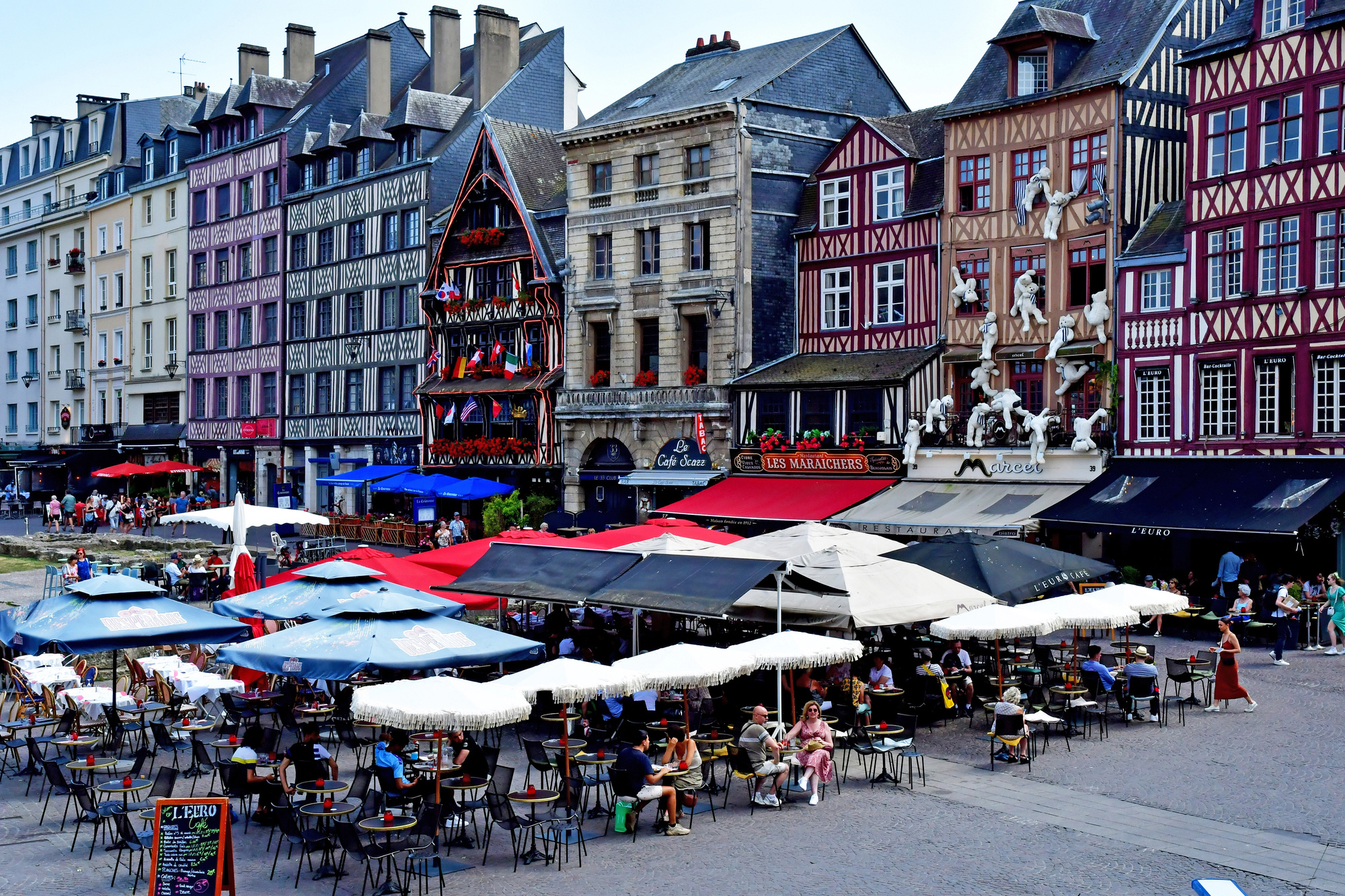
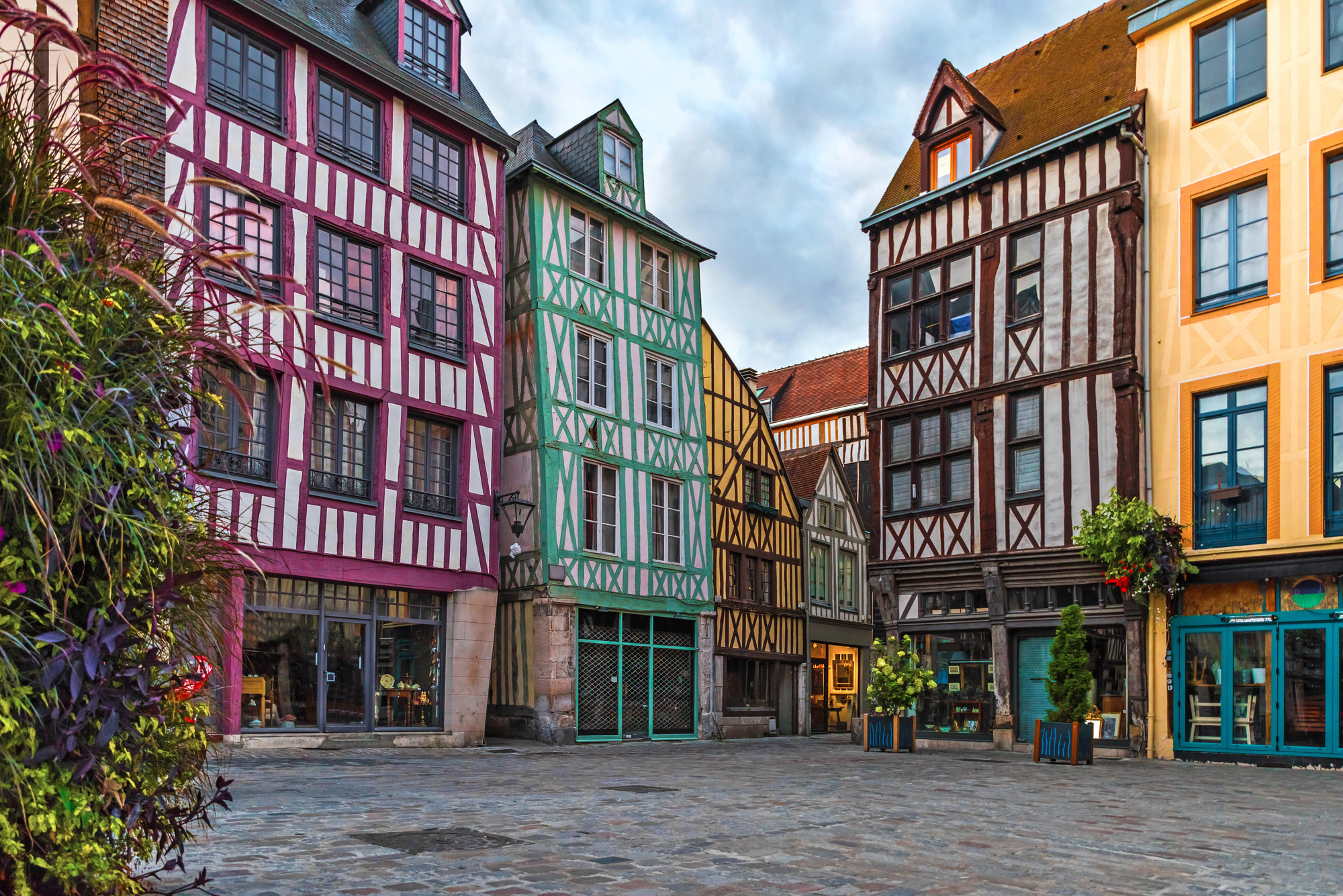
Running east from the market square is the Rue du Gros-Horloge, a pedestrian street of leaning half-timbered houses that ends under the clock itself. The movement dates from 1389 and tracks the phases of the moon alongside the hour. The single hand on the gilded dial is a reminder that for most of history, knowing the hour was enough.
Worth knowing, Rouen is an active city and conservation work moves around it, so a facade may be behind scaffolding when you arrive. It is rarely the whole building, and the rest of the old quarter makes up for it.
Monet and the Musee des Beaux-Arts
Monet returned to the same view of the cathedral’s west front in different weather and at different hours, and the resulting series is now scattered through collections worldwide. Seeing the real facade in flat Normandy drizzle, then seeing what he made of it, is the point of the exercise.
The Musee des Beaux-Arts, a short walk away, holds one of those canvases along with a serious collection of French painting, including the vast Jules-Alexandre Grun work in which the major figures are individually identified. Allow about an hour and a half. The church of Saint-Maclou, a few streets behind the cathedral, is worth the detour for its lacework Flamboyant Gothic facade alone.
When to go, and how Rouen fits a wider trip
- Late spring to early autumn gives the longest days, though rain can arrive in any month. Carry a light rain jacket and treat a wet afternoon as an excuse for the museum.
- Summer brings crowds but long evenings in the squares; September and early October are quieter and still comfortable.
- One full day covers the headline sights. Two lets you slow down and use the city as a base for the Normandy coast, the Seine valley abbeys or Monet’s garden at Giverny.
If you would like a trip through Normandy built around what you actually want to see, with the driving, timing and stays sorted before you leave home, that is the sort of planning we do at Cartier World Travel in Ballan.
Places to explore
Cathédrale Notre-Dame de Rouen (Rouen Cathedral)
Landmark and architectureThe west front Monet painted repeatedly is a cliff of carved stone that shifts character with the cloud. Inside, the ambulatory holds the effigy containing the heart of Richard the Lionheart, while the cast iron spire is the tallest in France.
Come in the first hour of opening for the Monet light, and allow about an hour inside.
Aître Saint-Maclou
Hidden historic siteA galleried timber courtyard built as a mass grave and charnel house after the Black Death, its posts carved with skulls, crossbones and dancing skeletons. Tucked behind the church on rue Martainville, it later housed an art school. The effect in low light is eerie.
Late afternoon sun rakes the galleries; look for the mummified cat in the glass case.
What Sam said
Joan of Arc was burnt at the stake for heresy. She said that she was the only person that would take instructions from God and from no one else. Sam Newman, on the ground
Sam Newman in Rouen
Filmed on Sam's own trip through Europe, parts of which Cartier World Travel arranged.
Other stops on Sam's journey

Rouen
Tell us roughly when and for how long. We build the rest around you, the way we built Sam's.