
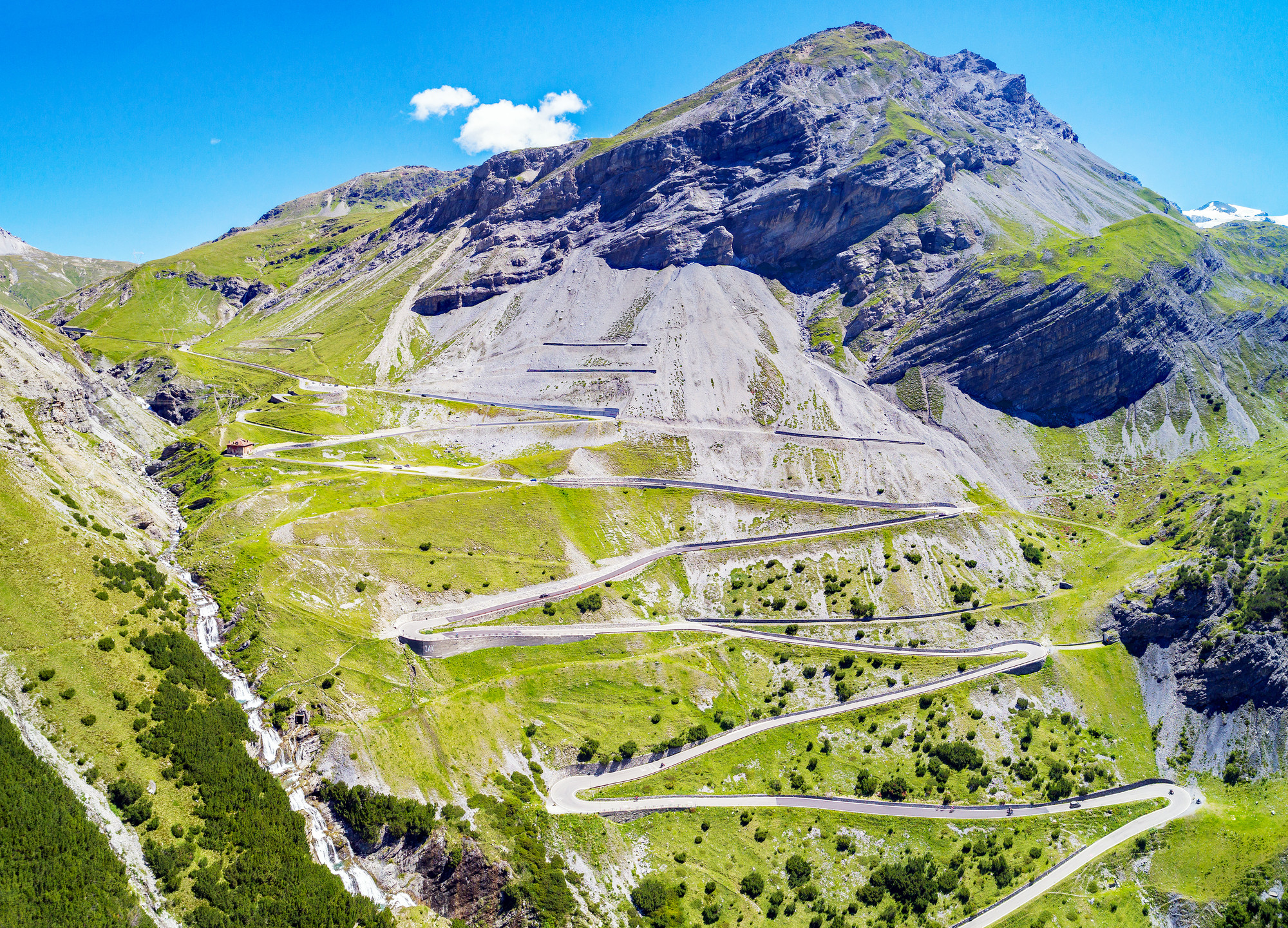
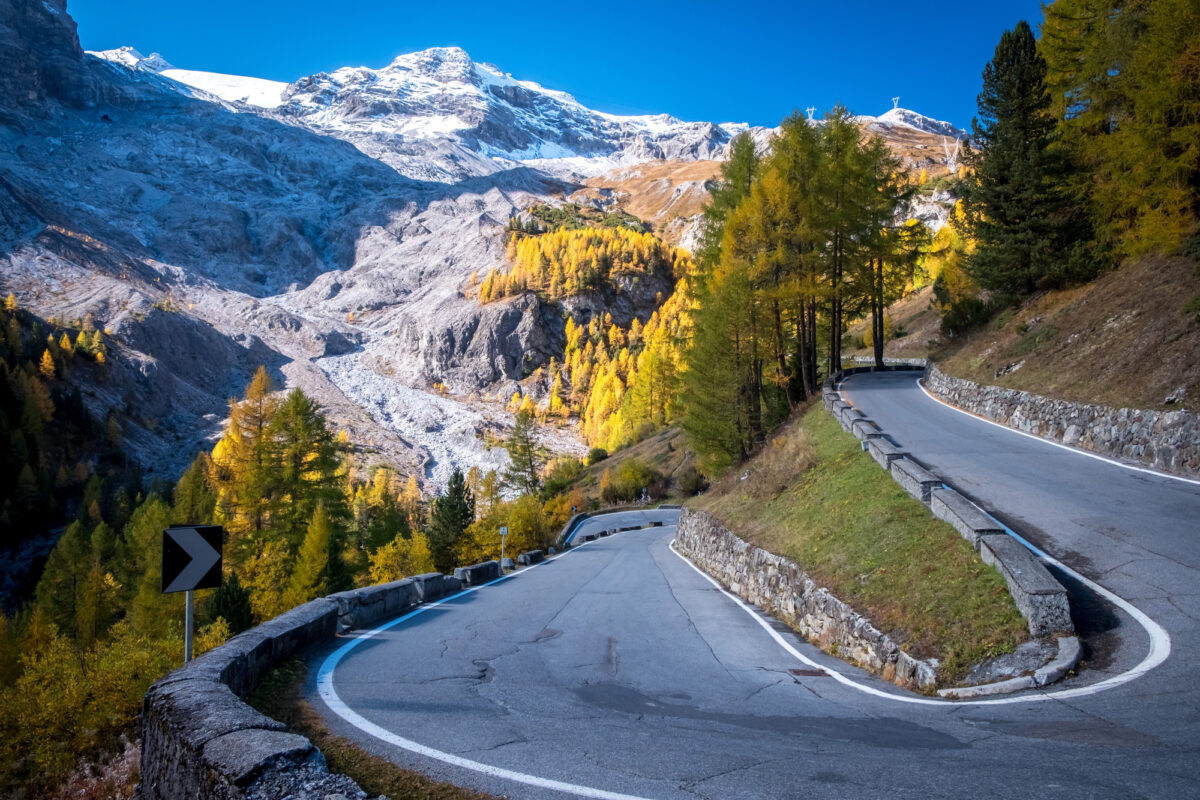
The Stelvio is one of those rare roads where the tarmac is the destination. A ladder of hairpin bends stacked up a mountainside in Italy’s far north, it climbs past 2,700 metres into thin, cold air on the border of South Tyrol and Lombardy. People travel a very long way to drive something that takes less than an hour to complete, and once you see it rising above you in tiers, the appeal makes sense.
This is Italy’s German speaking north, close enough to Switzerland and Austria that a single day’s driving can touch several countries. Signs change language, the architecture turns alpine, and the food leans towards dumplings and speck rather than pasta.
What the drive is like
The northern approach from Prato allo Stelvio is the one in the photographs, a wall of numbered switchbacks that looks drawn rather than built. They are often called paperclip turns, and the name fits: the bends are tight enough that you are almost facing back the way you came. The southern side, up from Bormio, is narrower and more tunnelled, with rock overhangs and drops that arrive without much warning.
Speed is neither the point nor really possible. Much of the climb is taken at a crawl, partly because of the geometry and partly because of the traffic. Motorbikes come through in packs, cyclists grind up in low gear, and sports cars appear around blind corners. Courtesy does most of the work at the pinch points. Some stretches have no guard rail at all.
Weather is the other variable. Cloud sits on the pass regularly, even in high summer, and rain or fog can reduce the whole spectacle to twenty metres of wet bitumen. It is still worth doing, with the terrain appearing in gaps as the cloud clears.
A note on vehicles
Signs on the approach discourage camper vans, with good reason. A compact car with decent brakes suits the road, as does a driver comfortable reversing, giving way and taking their time. If anyone is prone to motion sickness, put them in the front and plan a stop at the top.
The approach and the valley
The Vinschgau valley leading towards the pass is underrated in its own right: orchards, stone villages, tunnels and lakes, and a road that narrows through towns built long before cars. The set piece is Lake Resia, where the bell tower of a drowned village stands alone in the water, the rest submerged when the valley was flooded for a reservoir. Warm up switchbacks through forest and pasture begin well before the pass proper.
When to go and how it fits
- The pass is closed by snow through winter and opens once crews clear it, usually from late spring until autumn, which suits Australians travelling June to September.
- Early in the day means less traffic and a better chance of clear air before afternoon cloud builds.
- Take warm layers regardless of the valley forecast, as the summit can be close to freezing.
- It links naturally to the Italian lakes, the Dolomites, the Engadin in Switzerland and the Tyrol in Austria.
Two or three nights in the valley at either end allows the pass to be driven on a morning with decent weather rather than on your only available day.
What Sam said
It is quite a magical drive, and you can see why it is rated the world's most anxious drive. Sam Newman, on the ground
Sam Newman in Stelvio Pass
Filmed on Sam's own trip through Europe, parts of which Cartier World Travel arranged.
Other stops on Sam's journey
Stelvio Pass
Tell us roughly when and for how long. We build the rest around you, the way we built Sam's.