Most travellers come to Bulgaria for the Black Sea or for Sofia, and drive straight past the mountain road that holds the country together. Visiting Shipka Pass is a different kind of day out. It is a high, wooded crossing of the Balkan Mountains, a cobbled climb between steep shoulders of forest, and at the top of it stands the monument Bulgarians will tell you is the most significant in the country. You go for the history, you stay for the view, and you feel the stairs in your legs for two days afterwards.
The pass that made a country
Shipka Pass carries the road over the Balkan range between the Danube plain in the north and the Valley of the Roses in the south. Whoever holds it controls the movement of an army, which is precisely why it was fought over so bitterly during the Russo-Turkish War of 1877 to 1878. Russian and Bulgarian forces held these heights against repeated Ottoman assaults, and the outcome here is bound up with Bulgarian liberation in a way that is still taught, still commemorated and still visibly marked on the mountainside.
That history is not tucked away in a museum. It is scattered across the slopes in stone. There are monuments to regiments, to generals, to the unknown soldier, and one of the more affecting ones honours the women who carried water and food up to the men holding the ridge. Driving the pass itself is oddly undramatic at first, a narrow road with hills on either side, and then you realise that the undramatic bit is the point. Four major battles were fought over this strip of ground.
Climbing to the Monument of Freedom
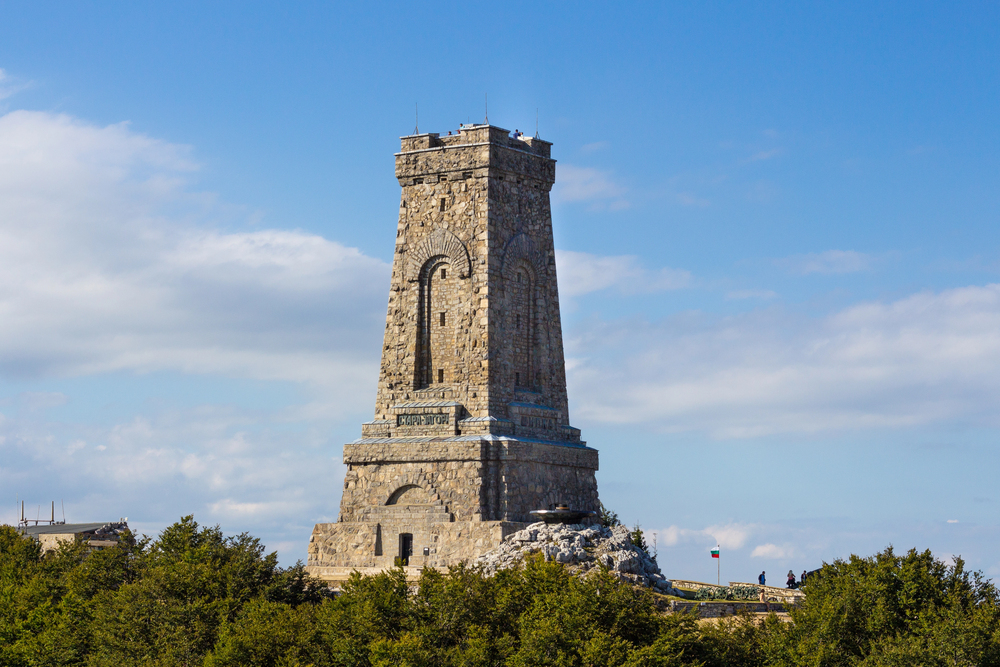
The Monument of Freedom sits on Stoletov Peak, a squat stone tower with a lion at its base, visible from a long way off. Getting to it is the part nobody warns you about. A long stone stairway climbs from the roadside car park, somewhere in the order of a thousand steps, and it delivers you to a landing where a reasonable person assumes the job is done. It is not. Another flight of roughly 400 steps carries on to the monument itself.
Take it in stages. There is no prize for speed, the views back down the wooded valley improve with every rest stop, and the memorials along the way are worth stopping for anyway. At the top you will find cannon positions, the Bulgarian flag, ridges running away into haze in every direction and a brazier that once held an eternal flame. The tower is hollow and can be entered, so allow time at the summit rather than treating it as a photograph and a turnaround.
What to wear and carry
Proper shoes, water, a hat in summer and a windproof layer whatever the season. The peak is exposed and considerably cooler than the valley floor, and the stone steps are uneven in places. Anyone in the group who would rather not tackle the climb can wait at the road, where there is parking and a view over the pass.
What visiting Shipka Pass actually involves
This is a half-day at minimum if you want to do the monument properly, and a comfortable full day if you add the valley below. A hire car is the sensible way to do it. The road is sealed and well used, but it is a mountain pass, with switchbacks, slow trucks and weather that can turn while you are on the stairs.
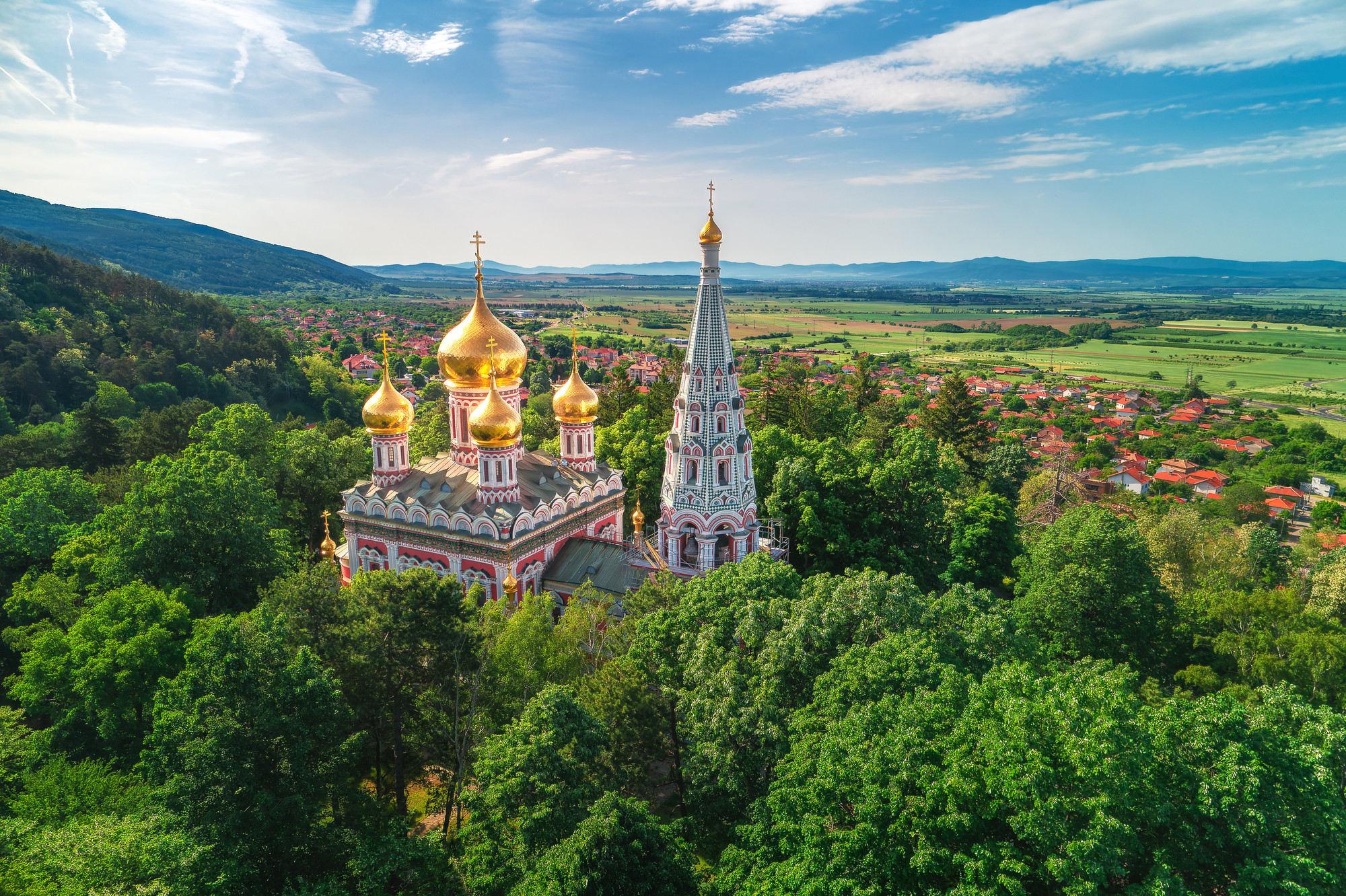
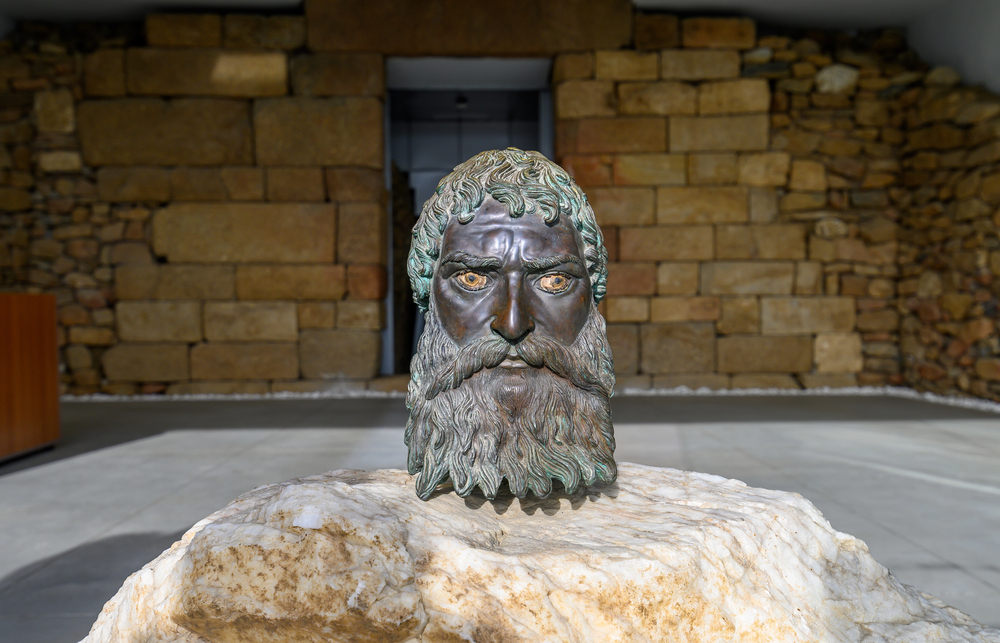
Further down the slope towards the village of Shipka stands the memorial church, an unmistakable Russian-style building with gold domes rising out of the trees. The town of Kazanlak lies on the southern side, at the heart of the Valley of the Roses and the Valley of the Thracian Kings, where the painted tomb at Kazanlak is on the UNESCO World Heritage list. Pairing the pass with the valley gives you Bulgaria at both ends of its story, a Thracian burial chamber in the morning and a nineteenth century battlefield in the afternoon.
When to go and how it fits a longer trip
Late spring through early autumn is the window. The valley below is at its most fragrant in the rose season of late spring, summer brings warm days that make the climb hard work but the visibility excellent, and early autumn gives you cool air and colour in the beech forest. In deep winter the pass can be snowbound and the stairway is no place to be on ice.
Shipka works beautifully as the middle leg of a Bulgarian loop, most often between Sofia and the old town of Veliko Tarnovo, and it sits comfortably in a wider Balkan itinerary that takes in Croatia and the Adriatic before turning inland. If you want the country beyond the beach resorts, this mountain road is where to start. We build trips like this one stop at a time, around the pace you actually want to travel at, and we are always happy to talk through how Bulgaria might sit inside a longer European route.